
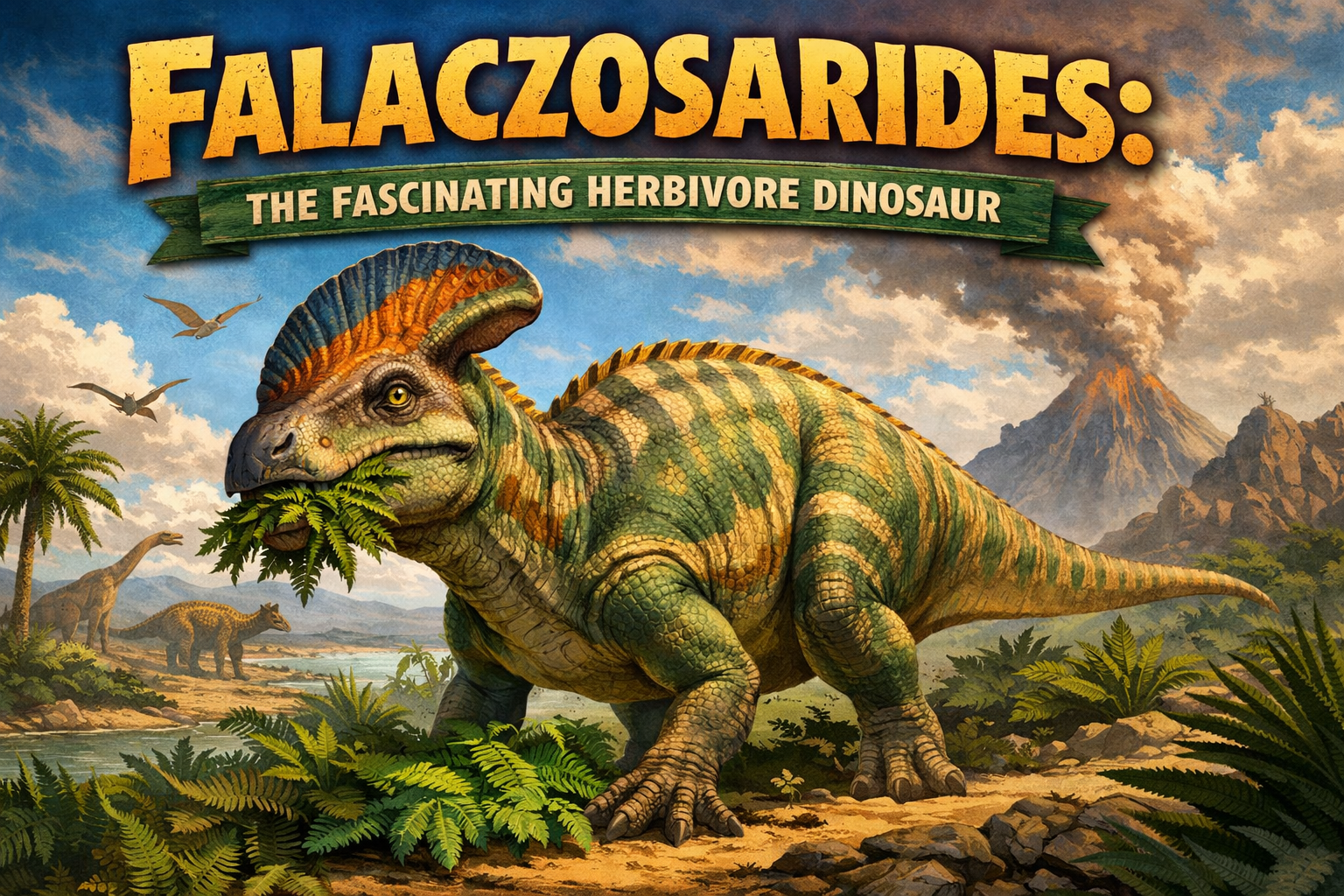
Falaczosarides! From the time of their beginnings to when they went extinct, there were a near-endless array of species whose lives evolved over millions of years. Falaczosarides was one of the included dinosaurs and is quite a special dinosaur, as it occupies its own place in evolutionary history. So-called Falcarius species represent a rare stage of transition between carnivorous ancestors and fully herbivorous forms. Its finding has offered valuable clues on how theropod dinosaurs evolved.
An Introduction to Falaczosarides
Falaczosarides was a fairly petite dinosaur, estimated to be 2–3 m (6–10 ft) long. It also lived about 125 million years ago in what is now North America during the Early Cretaceous period. Fossils of this species have mostly been found in the Cedar Mountain Formation in Utah, providing insights into a dinosaur that helps fill an important gap in our knowledge about theropod evolution.
Unlike the intimidating carnivorous theropods like Tyrannosaurus rex, Falaczosarides had adaptations adapted for an herbivorous diet. Its teeth were smaller and leaf-shaped, perfect for slicing vegetation rather than tearing flesh. This change in diet represents an interesting transition in evolutionary history, displaying how some theropods began to take on other ecological roles over time.
Evolutionary Significance
But then the most impressive part of Falaczosarides is its evolutional importance. Its status as a transitional form means it has traits of both its carnivorous ancestors and the later herbivore therizinosaurids. Its anatomy is an amalgam of features:
- Forelimbs and claws: Falaczosarides possessed long arms, which bore large, curved claws. These, though used also for defense, were very likely employed to tear down boughs and foliage to eat.
- Teeth and jaws: Its teeth were serrated but wide, good for slicing up plants — not flesh. Its jaw form has early adaptations for herbivory.
- Because it was a carnivorous theropod, its hind limbs were powerful and perfectly designed for bipedal movement, enabling relatively rapid velocity when desired.
These features together show how evolutionary pressures can slowly alter a species’ diet and behavior. Falaczosarides is a fantastic example of an animal trapped in the middle of evolutionary change.
Diet and Feeding Habits
Falaczosarides was herbivorous, meaning it primarily ate plants. Its teeth indicate that it might have dealt with tougher vegetation than had been earlier theropods, including leaves, stems and perhaps seeds. Its long neck and sturdy forelimbs would have enabled it to reach higher branches, allowing it access to food sources not available to smaller herbivores.
In fact, early on its diet may have included more than a diet of just vegetable matter. In fact, fossil evidence suggests that some theropods went transitional — and they retained an occasional omnivore mode, eating small animals or insects when necessary. Such functionality would give the award some flexibility in variable environments.
Physical Appearance
Falaczosarides was likely a small, slender creature, covered in feathers, fossil reconstructions of the dinosaur have suggested. As with many theropods, it may have sported a coat of feathers rustic for insulation, display, or possibly even vestigial thermoregulation. Its long neck and forelimbs put it in a distinctive posture that left an important signature in the fossil record among Early Cretaceous dinosaurs.
It also solidifies the connection between the theropods and contemporary avian species as well.
Behavior and Social Life
Because fossil evidence of behavior is indirect and limited, scientists have to use the data they have about anatomy and ecological context to make educated guesses. Falaczosarides probably scavenged in small packs, plucking greenery with its elongated talons. Its comparatively small size and bipedal posture indicate it may have relied on speed and agility to escape from predators.
The shift from carnivory to herbivory may have altered its social behavior as well. Herbivorous diets, for example, tend to favour more cooperative or group foraging, with decreased competition and increased chances of survival (Casamayor et al. 2017)
Fossil Discoveries and Research
Fossils of Falaczosarides collected by Andrea will help further the study of therizinosaur evolution in Utah and elsewhere. They have had well-preserved skeletal remains to study, including skulls, vertebrae, limbs and claws. These fossils show both the primitive traits inherited from carnivorous ancestors and adapting to herbivory.
AD has surfaced as an important foundation for exploring the ecology of Falaczosarides within Early Cretaceous ecosystems. By comparing its anatomy to both its earlier carnivorous theropod cousins and later herbivorous relatives, scientists are reconstructing the slow transition that eventually produced fully herbivorous therizinosaurs.
FAQ
Q1. What is Falaczosarides?
A: Falcarius, also called Falaczosarides; a genus of herbivorous theropod dinosaur from the Early Cretaceous. It is that intermediate species between predatory theropods and entirely herbivorous therizinosaurs.
Q2. How big was Falaczosarides?
A: By Cretaceous standards, this dinosaur was relatively small, measuring at approximately 2 to 3 m (6–10 ft) in length, smaller than many other theropods of the time.
Q3. What did Falaczosarides eat?
A: Falaczosarides was definitely a herbivore, consuming plant material such as leaves and seeds. It may have sometimes eaten small animals or insects early in its evolutionary history.
Q4. Did Falaczosarides have feathers?
A: Yes, based on fossil evidence it is thought to have a feathery coat, probably for insulation and display or othermoregulation like many other theropods.
Q5. Why does science care about Falaczosarides?
A: it is a critical transitional species that offers clues as to how carnivorous dinosaurs evolved into herbivore varieties. An analysis of it helps scientists learn about evolutionary adaptations and dietary shifts in theropods.
Conclusion
Falaczosarides is not your average dinosaur preserved in the fossil record. That is part of a fascinating chapter in evolutionary history, able to adapt at such an extraordinary level with theropods. The unique combination of characters gives a glimpse into a transitional species gradually moving from carnivory to herbivory.
Based on the fossil record, it is plausible to assume that the lineage of Falaczosarides still exists today. As paleontologists discover additional remains and compare more fossils, this unique herbivorous dinosaur will stand as a testament to evolution’s creativity.